


Small commercial quadcopters are among the fastest-growing segments of discrete electronics manufacturing. Whether built for agricultural surveying, infrastructure inspection, or logistics delivery, these products share a set of operational characteristics that stress-test an ERP system in ways that conventional manufacturing does not: rapid design iteration, globally fragmented component sourcing, deep traceability requirements, and production volumes that can spike unpredictably as new contracts land.
For implementation partners like Evomatiq, this category of manufacturer is a compelling proving ground for Sage X3’s capabilities. Here’s what a deployment looks like—and where the implementation differs from a typical discrete manufacturing engagement.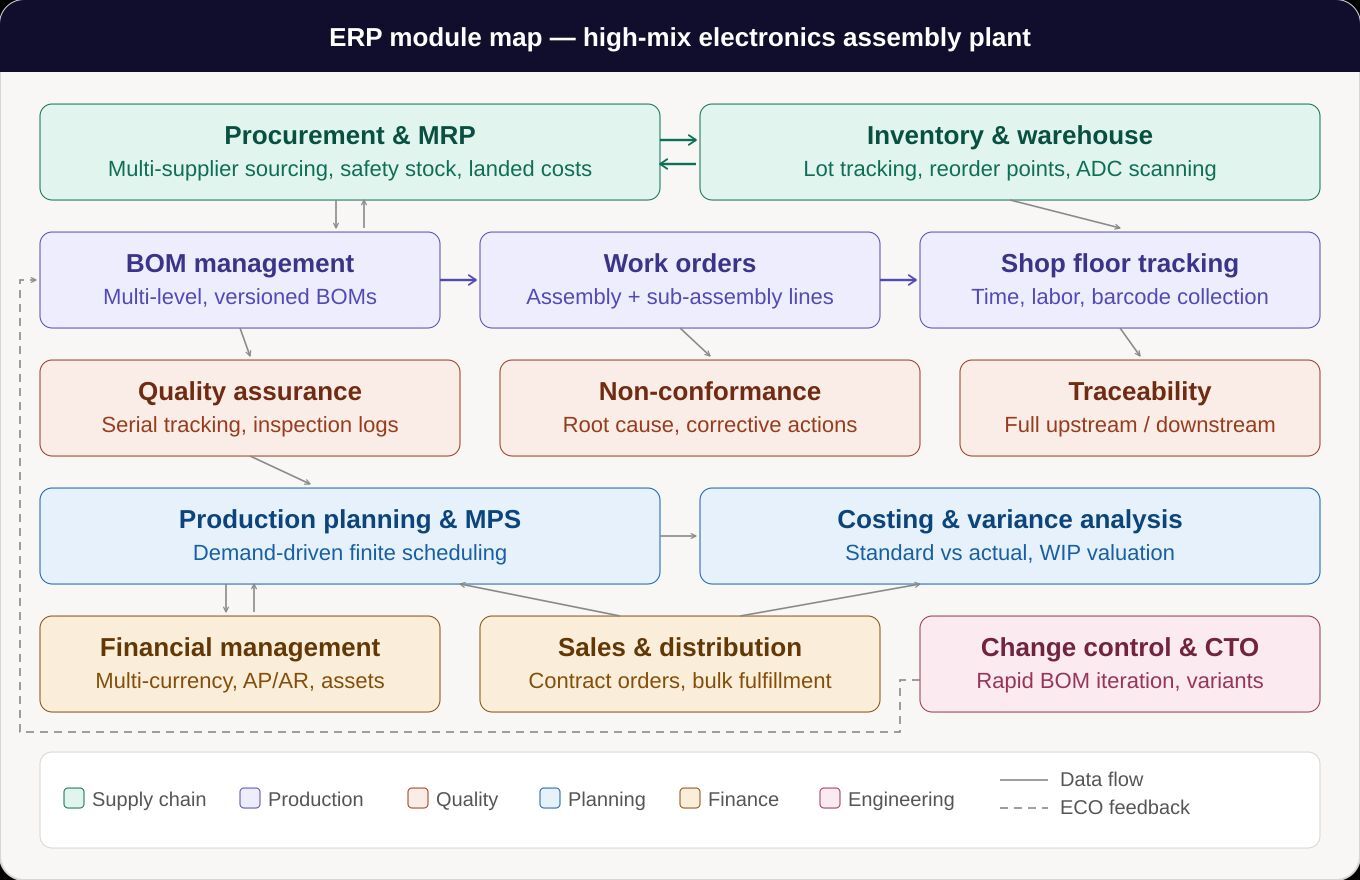
BOMs that won’t sit still
In conventional discrete manufacturing, a bill of materials might be revised quarterly. In high-mix electronics assembly, particularly quadcopter production, BOM changes happen weekly or even daily. A motor supplier runs out of stock, a flight controller board gets a new revision, a frame material proves too brittle in testing. Each change cascades through procurement, costing, and work orders.
Sage X3’s multi-BOM and version management handles this natively. Major and minor version tracking, mass maintenance of technical data, and a formal change control management process ensure that no BOM revision goes live without an auditable approval trail. For "configure to order" scenarios, where different contracts require different payload configurations, camera modules, or frequency bands, Sage X3’s product configurator generates variant BOMs directly from the sales order.
Procurement built for fragmented supply chains
The components in a commercial quadcopter like ESCs, brushless motors, FPV cameras, Li-Po batteries, GPS modules, etc, are sourced from a global network of suppliers, many of them concentrated in a single region. Lead times are unpredictable, stockouts are frequent, and alternative suppliers may offer subtly different specifications.
The ERP’s MRP engine needs to work harder here than in a stable supply environment. Sage X3 supports multiple suppliers per product-site, aggressive safety stock policies, and Advanced Purchasing Cost (APC) management that factors landed costs, freight, duties, insurance into the true cost of each component using Incoterms. The Buyer’s Workbench becomes a daily operational tool rather than a periodic review screen, enabling real-time supplier switching when a preferred source is unavailable.
Traceability from component lot to finished unit
Every assembled quadcopter needs a complete provenance record: which batch of motors, which lot of flight controllers, which firmware version was flashed, which operator performed the final inspection. If a batch of ESCs shows an elevated failure rate, the manufacturer needs to trace forward to every unit that used them and potentially issue a recall or rework.Sage X3’s quality assurance module provides serial number management, lot and sub-lot tracking, stock status management (accepted, rejected, inspected), and upstream/downstream traceability. Combined with Automated Data Collection (ADC) via barcode-equipped handhelds on the assembly line, traceability is built into the production flow rather than requiring after-the-fact data entry.
Production scheduling under demand volatility
A plant producing commercial quadcopters may run three or four variants simultaneously on the same lines, with production volumes that shift rapidly as new orders arrive. The scheduling challenge is finite-capacity, fast-changeover, and demand-responsive.Sage X3’s production scheduler supports constraint-based finite-capacity scheduling, multi-criteria load analysis, and graphical Gantt views that production managers can interact with directly. Work order grouping allows batching of similar variants to minimise changeovers, while the Master Production Schedule (MPS) provides the longer planning horizon that MRP feeds from.
What changes in the implementation approach?
A standard Sage X3 implementation for a mid-market manufacturer might run 12–18 months. For a high-mix electronics plant where speed-to-production is a competitive differentiator, the approach compresses significantly:
Phase 1 (Weeks 1–6): Inventory, BOM management, and procurement go live first. These are the operational bottleneck—without component visibility, nothing else works.Phase 2 (Weeks 7–12): Work orders, shop floor tracking, and quality/traceability. Barcode scanning at every assembly station is configured and tested during this phase.
Phase 3 (Weeks 13–18): Financial management, costing, advanced planning, and change control. The configure-to-order module is typically tuned during this phase as variant requirements stabilise.
The critical difference is that shop floor data collection using ADC handhelds, barcode scanning at receipt and assembly, automated production declarations is treated as core infrastructure, not an add on. In a plant where traceability is non negotiable, the ERP must capture data at the point of action, not rely on manual entry after the fact.
The implementation partner’s role
For a product category that evolves this fast, the ERP implementation can’t be a one-time project. The partner needs to remain engaged for ongoing BOM structure optimisation, MRP tuning as supply chains shift, and configuration of new product variants as the manufacturer’s portfolio expands. At Evomatiq, we approach these engagements as long-term operational partnerships—not handoff projects.
If your manufacturing operation is dealing with rapid design cycles, complex component sourcing, or the need for unit-level traceability, we’d welcome a conversation about what Sage X3 can do for your plant.
