


If you run a growing company in the UAE, 2026 is not a neutral year to be choosing an ERP system. The Federal Tax Authority's e-invoicing pilot opens in July 2026. Businesses with annual revenue of AED 50 million or more must be issuing structured e-invoices by 1 January 2027, and most other VAT-registered businesses follow by 1 July 2027. Whatever system you choose now will either carry that compliance load for you or become the reason you scramble later.
This guide walks through how we advise clients to evaluate ERP systems for medium-sized companies: what to look for, what to be sceptical of, and what an implementation genuinely takes. It is written for the people who actually sign off on these decisions, usually a finance manager, an operations director, or the owner.
First, be honest about why you're looking
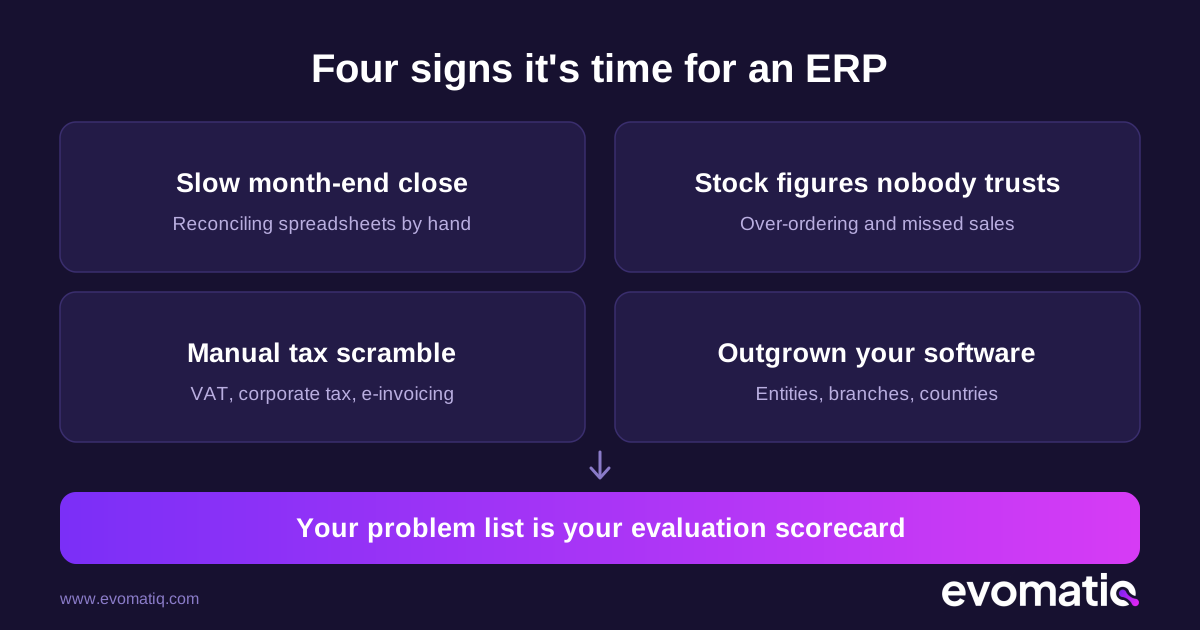
Enterprise resource planning software is a means, not an end. Before you look at a single demo, write down the three or four problems that are costing you money or sleep. In the mid-market companies we work with across the GCC, they tend to look like this:
- Month-end close takes too long because finance is reconciling spreadsheets from sales, inventory, and operations by hand.
- Nobody trusts the stock figures, so you over-order to be safe or lose sales because the system said an item was available when it wasn't.
- VAT and corporate tax reporting is a manual scramble, and e-invoicing is about to make manual untenable.
- You've grown into multiple entities, branches, or countries, and your current accounting software was never built for that.
Your problem list is your evaluation scorecard. Every vendor demo should be measured against it, not against the vendor's feature list. If a system dazzles you with capabilities that solve none of your four problems, it is the wrong system, however impressive.
Seven ERP selection criteria that matter for UAE mid-market businesses
1. Fit for your size, not aspiration or nostalgia
SMB ERP systems and enterprise platforms fail in opposite ways. Buy too small and you'll outgrow it in two years and pay for a second migration. Buy an enterprise-grade platform built for thousands of users and you'll pay enterprise prices for complexity you can't staff. Medium-sized companies, roughly 30 to 500 employees with multi-entity or multi-site operations, sit in a specific middle band. Look for systems designed for that band, and ask the vendor directly: what is the typical size of your customer, and what happens at double our current volume?
2. Industry depth, not industry marketing
Every ERP vendor claims to serve your industry. The test is whether the industry capability is native or bolted on. A distributor needs landed cost tracking and multi-warehouse inventory out of the box. A process manufacturer needs formula management, batch traceability, and quality control in the core product. Retail ERP solutions need to handle high transaction volumes and connect cleanly to point-of-sale. In demos, insist on seeing your workflows with your kind of data, not the vendor's polished sample company.
3. UAE and GCC compliance, built in and kept current
This is where 2026 raises the bar. Your shortlist should handle:
- UAE VAT at the transaction level, with FTA-ready audit files.
- Corporate tax, which puts new weight on clean entity-level books and reliable intercompany records.
- E-invoicing readiness. From your go-live wave, invoices must be issued as structured data through an accredited service provider on the Peppol network. A PDF from your system will not qualify. Ask every vendor precisely how their product will connect to an accredited service provider and who is responsible for keeping that connection compliant as the rules evolve.
- Multi-legislation and multi-currency, if you operate across the GCC, because Saudi Arabia and Oman are on their own e-invoicing paths.
A system localised for the UAE by a partner who lives with these regulations will serve you better than a global product that treats the Gulf as an afterthought.
4. Room to grow, priced honestly
Growing company software has to survive your growth plan, not just your current state. Adding a second entity, a new emirate, or a Saudi operation should be configuration, not a new project. Ask what it costs to add users, entities, and modules later. A low entry price with steep expansion pricing is a common trap, and it is worth modelling the five-year cost, not the year-one cost.
5. Integration with what you keep
An ERP rarely replaces everything. Payroll, e-commerce, point-of-sale, and industry-specific tools often stay. The question is whether the ERP has proper APIs and a track record of integrating with those systems, or whether every connection becomes a custom development you'll maintain forever. When we say an integration should be seamless, we mean it literally: data flows without manual re-entry or reconciliation.
6. The implementation partner matters as much as the software
Most ERP disappointments we're called in to fix were not caused by the software. They were caused by rushed scoping, weak data migration, and training that ended at go-live. When you evaluate a partner, ask:
- Who exactly will work on our project, and how many implementations like ours have they personally done?
- Can we speak to two clients of our size, in or near our industry, who went live more than a year ago?
- What does support look like in month six, when the consultants have moved on and a real problem appears at 4pm on a Thursday?
A partner who pushes back on your requirements during scoping is usually worth more than one who agrees to everything.
7. Total cost, including your own time
Licences are the visible cost. The full picture includes implementation, data cleaning, integrations, training, and the hours your own finance and operations people will spend on the project. That internal time is real and unavoidable. Any proposal that hides it is not being straight with you.
What an ERP won't do
Candour matters more in this purchase than in most, so here it is plainly:
- An ERP will not fix a broken process. It will run your process faster and more consistently. If your approval chains or stock practices are muddled, sort them out during implementation, or the system will simply automate the muddle.
- Go-live is not the finish line. Expect a settling-in period of two to three months where things feel slower before they feel faster. Teams need time to trust new numbers and new habits.
- Reports are only as good as discipline. Real-time dashboards depend on people recording transactions as they happen. That is a management commitment, not a software feature.
Any vendor or partner who tells you otherwise is selling, not advising.
A realistic timeline for 2026
For a medium-sized UAE business, a well-run ERP selection takes six to ten weeks: defining requirements, shortlisting two or three systems, structured demos against your scorecard, and reference calls. Implementation for a mid-market company typically runs four to nine months depending on complexity, data quality, and how much process change you take on.
Work backwards from the e-invoicing dates. If your revenue is at or above AED 50 million, your compliance deadline is 1 January 2027 and your accredited service provider should be appointed by 30 October 2026, which means your system decisions belong in the first half of this year. If you're below that threshold, 1 July 2027 gives you more room, but a selection started now means an unhurried implementation rather than a compressed one.
Where we fit
EvomatiQ is a Dubai-based Sage partner. We implement and support ERP, CRM, BI, and HRMS solutions for SME and mid-market businesses across the GCC, including Sage X3 for companies that have outgrown entry-level accounting software. Our clients tend to say the same two things about us: we keep things simple, and we tell them the truth about what a project will take.
We're not the right fit for everyone, and we'll say so early if we're not. But if you're weighing up ERP options against a 2026 deadline, a conversation costs you an hour and will leave you with a clearer shortlist either way.
Talk to us about your shortlist. Call +971 50 968 6128 or write to hello@evomatiq.com, and we'll walk through your requirements with you, no obligation.
EvomatiQ is an independent Sage partner. Sage and Sage product names are trademarks of Sage Global Services Limited.
