


If your finance team is consolidating entities in Excel, re-keying data between systems, or staring down the UAE e-invoicing deadline with a system that cannot produce structured invoice data, you have probably come across Sage Intacct.
This guide explains what it is, how it behaves in a UAE context, where it is the wrong answer, and how to decide whether it deserves a conversation. We are EvomatiQ, a Sage partner based in Dubai, and we implement it. We have tried to write the article we wish existed when we started.
The short answer
Sage Intacct is a cloud-based financial management platform. It is the system of record for your money: general ledger, accounts payable, accounts receivable, cash management, and the reporting layer above all of it.
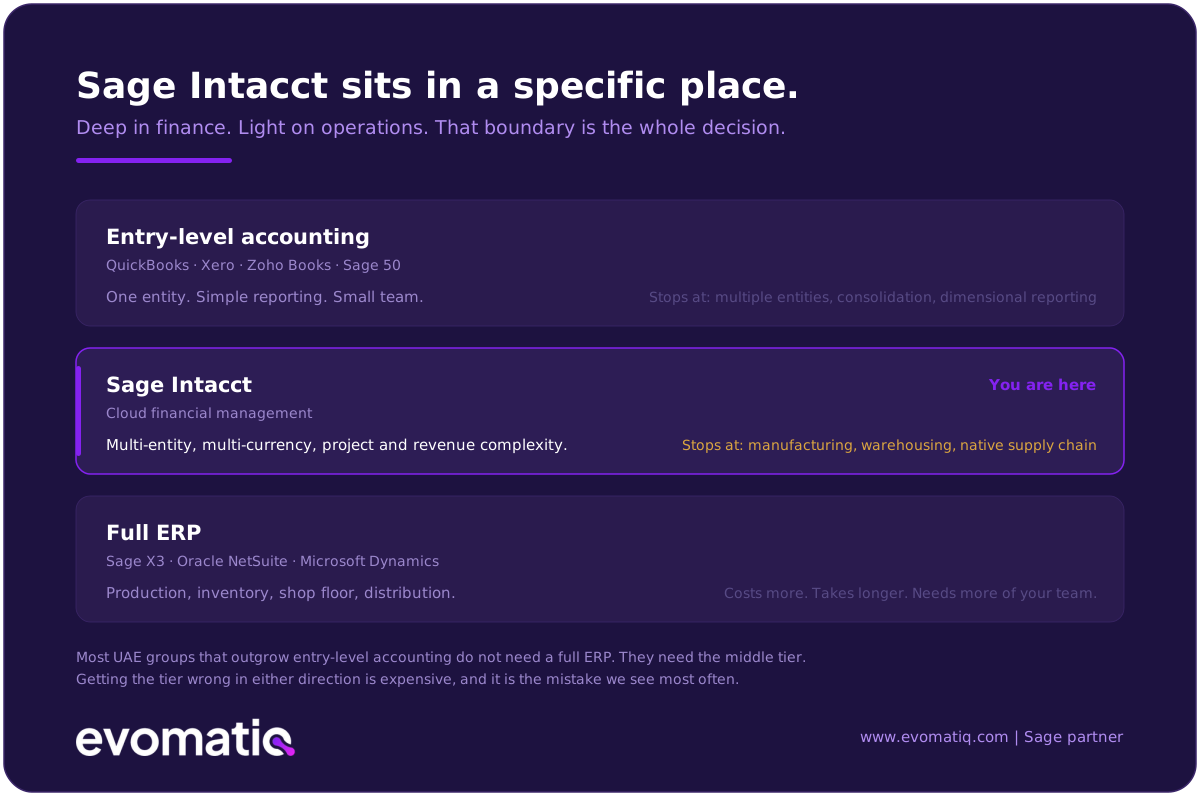
It sits at a specific point on the ladder. Below it are entry-level tools like QuickBooks, Xero, Zoho Books and Sage 50, which handle bookkeeping for a single company well and struggle beyond that. Above and alongside it are full ERP suites that also run manufacturing, warehousing and supply chain. Sage Intacct is best described as a cloud financial management platform with exceptional depth in financials, project accounting, subscription billing and revenue recognition, but without native inventory, manufacturing or supply chain capability.
That boundary is deliberate. It is built for organisations where finance is the complicated part.
Sage Intacct in the UAE
Sage brought Sage Intacct to the UAE market in October 2025, delivered through certified business partners with vertical expertise rather than sold direct. That matters for two reasons. First, it is a relatively recent arrival here, so the local implementation base is younger than in the US or UK. Second, the partner does the work, which makes partner selection as consequential as software selection.
Who it fits
In our experience in the Gulf, Sage Intacct tends to suit organisations with some combination of:
- Multiple legal entities. A mainland company plus one or more free zone entities, a holding structure, or subsidiaries across the GCC. This is the single strongest indicator.
- Multi-currency reality. AED functional with USD, SAR, EUR or GBP transactions, and group reporting that has to reconcile.
- Finance-led complexity. Professional services, SaaS and software, nonprofits and foundations, healthcare groups, financial services and family offices, real estate and construction.
- Reporting demands the current system cannot meet. Leadership wants profitability by project, by entity, by location, by client, and nobody can produce it without a spreadsheet exercise.
- Regional expansion. You are adding entities faster than your finance system can absorb them.
If you are a single-entity company with simple reporting, Sage Intacct is more platform than you need. We would rather say that now than in month three of an implementation.
The thing that actually makes it different: dimensions
This is the concept worth understanding, because it is the core of the product and it works differently from most accounting systems.
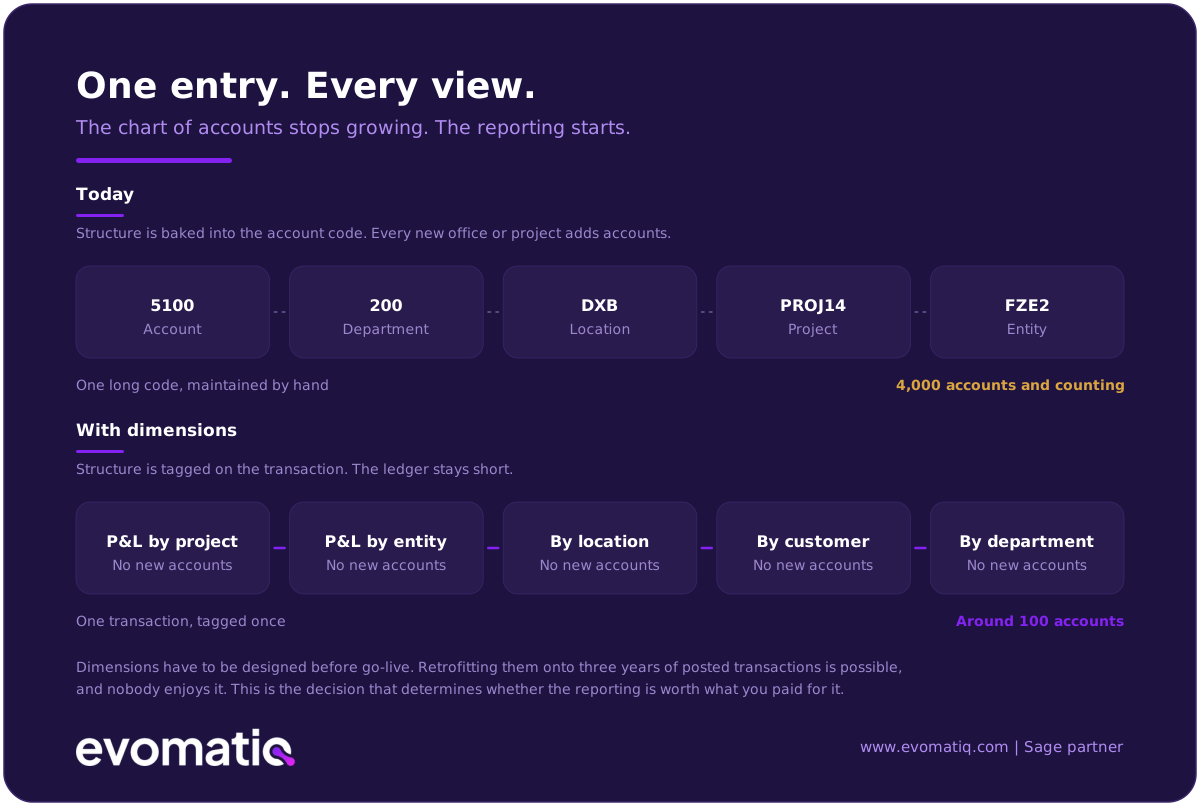
Traditionally, if you want to report by department, location and project, you build those distinctions into the chart of accounts. You end up with codes like 5100-200-DXB-PROJ14. Add a free zone entity or a new project line and the chart grows another limb. Within a few years it runs to thousands of accounts, nobody remembers what half of them mean, and restructuring it becomes its own project.
Sage Intacct inverts this. It keeps the general ledger short and clean, then tags every transaction with dimensional values such as entity, department, location, project, customer, vendor, item and employee, plus custom dimensions you define. Your chart of accounts might hold 100 accounts instead of 4,000.
The payoff is reporting flexibility. You can produce a P&L by project, by entity, by location, or any combination, without re-coding the chart of accounts. A new Abu Dhabi office or a new fund becomes a dimension value, not a structural change.
For a non-finance reader: it is the difference between a filing cabinet with a fixed folder for every possible combination, and a database where you tag each record and filter it however you like afterwards.
How the product is assembled
Sage Intacct is modular, which matters for both scope and budget.
Every implementation begins with Core Financials, which is mandatory. It covers general ledger, accounts payable, accounts receivable, cash management, purchasing, order entry, reporting and dashboards.
From there you add what the business needs. Common additions include project accounting, contract and subscription billing, revenue recognition, fixed assets, inventory management, multi-entity global consolidations, budgeting and planning, and time and expense management.
It also integrates outward through a marketplace of partner applications and open APIs. In UAE deployments this is typically how Sage Intacct connects to payroll, CRM, banking, expense management and, increasingly, e-invoicing infrastructure.
Multi-entity and multi-currency: the usual reason UAE groups look at it
If you run more than one legal entity, this is normally the deciding factor.
Consolidation across entities and currencies happens inside the system in real time, with intercompany eliminations handled automatically, rather than as a month-end spreadsheet ritual. Shared vendors, customers and charts of accounts can sit at group level and flow down, so you are not maintaining the same vendor record in five companies.
For a UAE group with a mainland trading company, a couple of free zone entities and perhaps a Saudi subsidiary, this is the difference between a close that takes days and one that takes weeks.
UAE compliance: VAT, corporate tax and the e-invoicing mandate
This section is the one most UAE finance leaders actually came for.
VAT and corporate tax. Standard requirements: 5% VAT with FTA-compliant tax invoices and return filing, and corporate tax at the prevailing rate with its own registration, provisioning and disclosure obligations. Any serious financial platform should handle the tax treatment, the audit trail and the reporting. The real question is not whether it can, but how much manual work sits between the ledger and the filing.
The e-invoicing mandate is the bigger issue, and the timeline is tight.
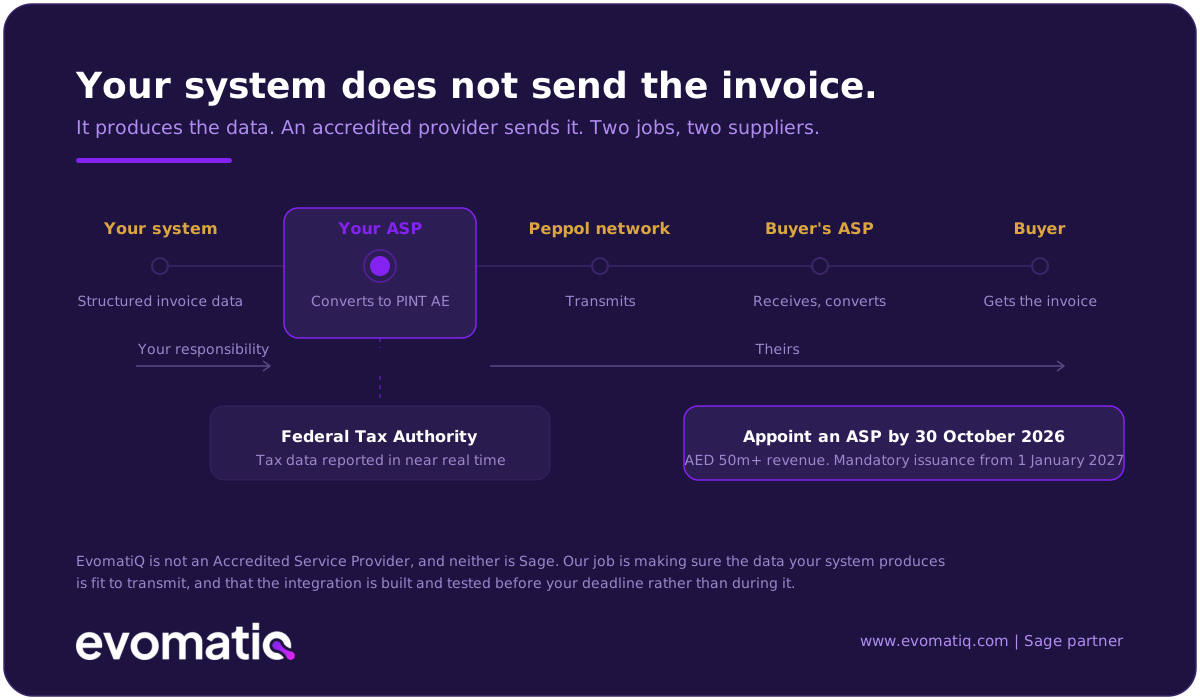
The UAE is moving to mandatory structured e-invoicing under a Peppol-based five-corner model, led by the Ministry of Finance and the Federal Tax Authority. Invoices become machine-readable XML transmitted through Accredited Service Providers, with tax data reported to the FTA in near real time. The Ministry has been explicit that unstructured formats such as PDFs do not qualify as e-invoices under the mandate.
The confirmed timeline:
- 1 July 2026: voluntary pilot phase opened.
- 30 October 2026: businesses with revenue of AED 50 million or more must have appointed an Accredited Service Provider. This was extended from the original 31 July 2026 deadline.
- 1 January 2027: mandatory e-invoicing begins for those businesses.
- 31 March 2027: ASP appointment deadline for smaller businesses and government entities.
- 1 July 2027: mandatory e-invoicing for businesses under AED 50 million.
- 1 October 2027: mandatory for government entities.
Scope currently covers B2B and B2G transactions. B2C sits outside the mandate for now. The FTA has published the full semantic model, running to 51 mandatory fields per electronic tax invoice, aligned to the UAE's national PINT AE specification, with your Tax Identification Number acting as the participant identifier on the network.
What this means for your finance system, specifically.
There is a common misunderstanding worth clearing up. The mandate does not change your VAT rate or your corporate tax position. It changes the plumbing through which invoices flow. Your ERP or accounting system generates the invoice data; an Accredited Service Provider converts, validates and transmits it over the Peppol network and reports to the FTA.
So you need two things, not one:
- A system capable of producing complete, structured, field-accurate invoice data. If your current setup relies on manual invoice creation, free-text fields, inconsistent customer master data or Excel, this is where the mandate will hurt. Fifty-one mandatory fields is unforgiving of a messy customer master.
- An accredited service provider appointed from the Ministry of Finance list.
This is the honest reason the mandate matters for a platform conversation. It is not that a new ERP makes you compliant by itself. It is that the mandate exposes data-quality and process problems that most organisations have been absorbing manually, and those problems do not survive contact with real-time structured reporting.
If you want to know precisely how Sage Intacct handles PINT AE output and which ASP integration path applies to your setup, ask us on a fit call. We will give you the current position rather than a marketing answer.
The AI layer
This moves fast, so treat any article older than a year with suspicion, including this one eventually.
Sage Copilot is the embedded AI assistant inside Sage Intacct, alongside specialised agents covering financial analysis, close, accounts payable, assurance and time entry. Sage announced a significant expansion of AI agents across finance, HR and operations in April 2026, with the emphasis on agents that act on work rather than only describe it. Sage ships updates to all customers quarterly, so the capability list keeps growing.
In practice this currently means drafting bills from emailed invoices, flagging duplicate or anomalous transactions, tracking close status across subledgers, and querying your financial data in plain language.
Our advice: evaluate the platform on fundamentals (dimensions, consolidation, reporting, automation), and treat AI as an accelerant rather than the reason to buy.
Credibility markers worth knowing
Sage Intacct is the preferred provider of cloud financial applications of the AICPA, delivered through CPA.com, and remains the only accounting or ERP solution holding that endorsement. This matters practically, not just as a badge: audit firms tend to already know the system.
Sage also cites G2 rankings placing it first in customer satisfaction for accounting software, and for mid-market and nonprofit accounting software specifically. Vendor-published, so weigh accordingly, though the underlying G2 data comes from real users.
What it costs
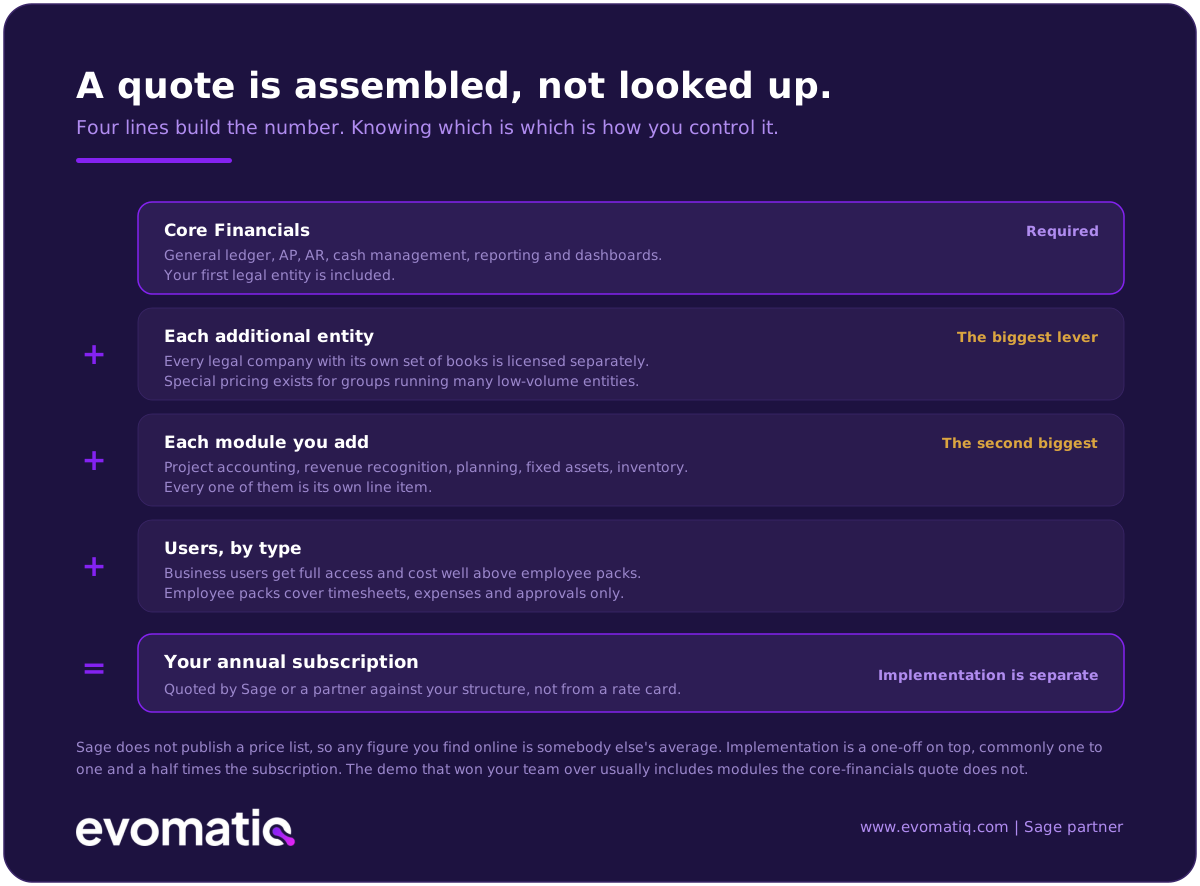
Sage does not publish a price list. Quotes are assembled from modules, user count and entity count.
User licensing is tiered. Business users get full access with permission controls, for the accounting team. Employee users get limited access, typically for expenses, timesheets and approvals. Your first legal entity is included in the core bundle, additional entities cost extra, and special pricing exists for organisations running many low-volume entities.
Published third-party estimates vary widely, which itself tells you something. Typical annual subscriptions reported by partners and advisory firms fall in the tens of thousands of US dollars, scaling with entities and modules. A common rule of thumb puts implementation at roughly one to one and a half times the annual subscription, with many projects completing in 60 to 90 days.
Treat those as orientation, not a quote. The two levers that move the number most are entity count and how far up the module ladder you go. We would rather scope you properly than quote you fast.
When Sage Intacct is the wrong answer
We implement several platforms, so we have no incentive to force a fit.
- You need deep inventory, manufacturing, or warehouse operations. Sage Intacct lacks that operational depth natively. For UAE manufacturers and distributors, Sage X3 is usually the better conversation, and it is one we also have.
- You are a single entity with straightforward reporting. A well-configured entry-level system will cost a fraction and do the job.
- Your problem is process, not software. New software does not fix an undocumented close or unclear ownership. It makes the mess faster and more expensive.
- You have no internal capacity. Implementation needs real attention from your finance team for a couple of months. If everyone is already at capacity, the honest answer is to wait or to resource it properly first.
Frequently asked questions
Is Sage Intacct an ERP?
It is a cloud financial management platform. It covers the finance side of ERP with unusual depth but does not include native manufacturing or supply chain. Whether you call that an ERP depends on what you need it to do.
Is Sage Intacct available in the UAE?
Yes. Sage launched Sage Intacct in the UAE in October 2025, delivered through certified partners.
Does Sage Intacct handle UAE VAT and corporate tax?
It handles the accounting, audit trail and reporting required to support both. Your specific configuration should be scoped against your entity structure and free zone status.
Will Sage Intacct make us compliant with the UAE e-invoicing mandate?
No single system does that on its own. Compliance requires both a system that produces complete structured invoice data and an Accredited Service Provider appointed from the Ministry of Finance list. Ask us about the current integration path for your setup.
How long does a Sage Intacct implementation take?
Commonly 60 to 90 days, though entity count, module scope and data quality move that materially.
Who implements Sage Intacct in the UAE?
Sage sells through certified partners in this market. EvomatiQ is a Dubai-based Sage partner implementing Sage Intacct for organisations across the UAE and Saudi Arabia.
Book a fit call
Most articles like this end with "request a demo." A demo shows you a polished version of somebody else's business. It is not much use in deciding whether the platform suits yours.
We would rather start with a fit call. Thirty minutes, no pitch deck. We will ask about your entity structure, how your close currently runs, what reporting leadership asks for that you cannot produce, where you sit against the e-invoicing deadlines, and what systems need to talk to each other.
At the end you get a direct answer on one of three things: Sage Intacct is a strong fit and here is roughly what scope and investment look like, it might be a fit but here is what we need to confirm, or it is not the right tool and here is what we would look at instead.
Come prepared if you can. Bring your entity list, a sample of your monthly reporting pack, and the one thing about your close that frustrates you most.
EvomatiQ Business Solutions, 644 Tamani Arts Office Tower, Business Bay, Dubai, UAE. hello@evomatiq.com, +971 50 968 6128.
